

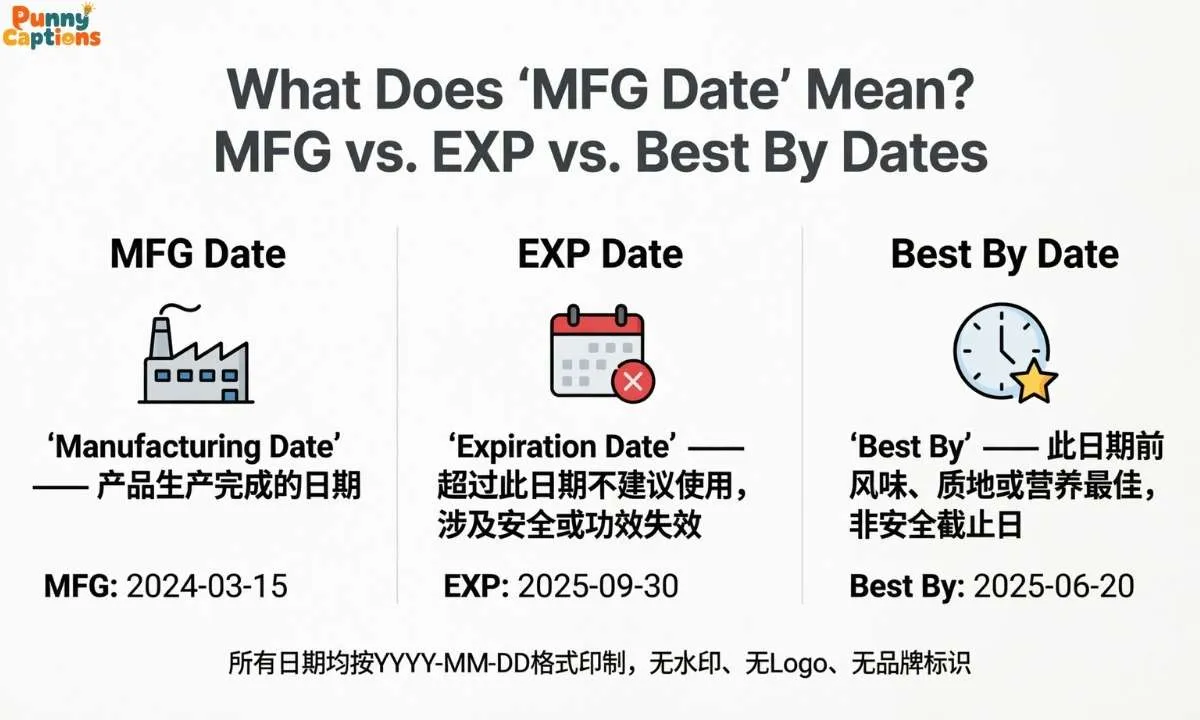
“MFG Date” is a common term you see on product labels. It stands for manufacturing date. This tells you when the product was made. It helps you understand how fresh the item is.
Many people confuse MFG date with other labels. Terms like EXP and Best By are also important. Each one has a different meaning. Knowing the difference can help you stay safe and smart.
The MFG date shows when the product started its life. The EXP date tells when it should not be used. Best By gives a quality suggestion, not a safety rule. Learning these terms makes shopping easier and better.
What Does the MFG Date Mean?

MFG is an abbreviation for manufacturing. The MFG date, therefore, refers to the date on which a product was manufactured, produced, or assembled. It marks the precise moment a product came into existence — the day it was formulated, bottled, packed, or processed at a production facility.
Unlike expiration dates or best-before dates, which tell consumers when a product will stop being safe or effective, the MFG date is a backward-looking marker. It does not tell you when a product will go bad; rather, it tells you how old the product already is. This distinction is critical. A product may still be within its expiration window while having an MFG date that suggests it has been sitting on a shelf for an unusually long time.
The MFG date is a neutral, factual data point. It is not a warning; it is a timestamp. However, when interpreted correctly — especially in combination with shelf-life guidelines — it becomes an extremely powerful tool for evaluating product quality and safety.
Comparison of Date Codes
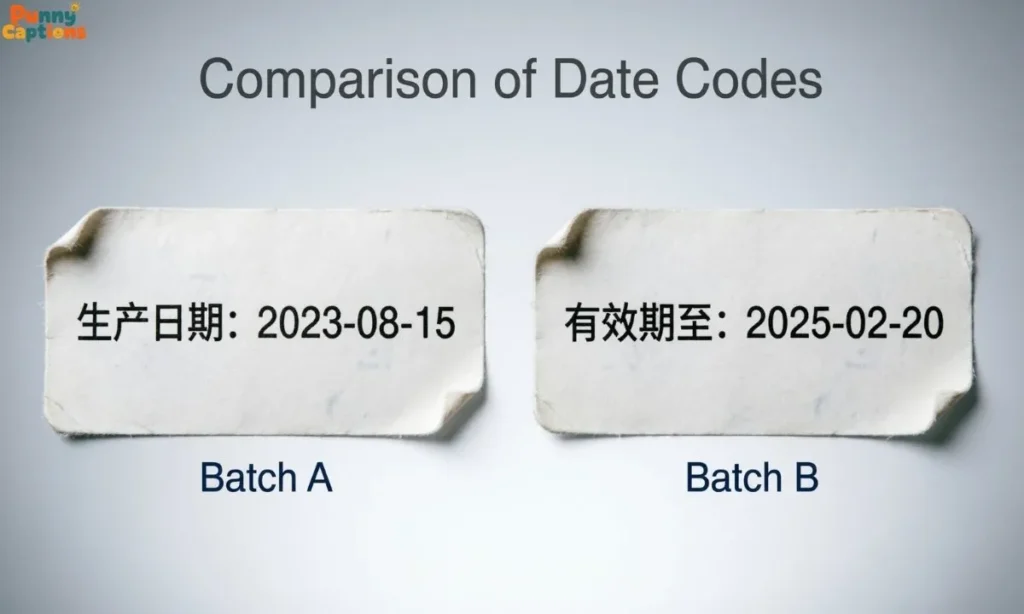
Before diving deeper into the MFG date specifically, it is helpful to understand how it compares to the other date codes commonly found on consumer products. The table below provides a brief overview:
| Date Code | What It Indicates | Consumer Action |
| MFG Date | When the product was made | Calculate age and remaining shelf life |
| Packaging Date | When the product was packed | Often same as MFG; relevant for bulk goods |
| Expiration Date | Last date of guaranteed safety/efficacy | Do not use after this date |
| Best Before Date | Last date of optimal quality | Safe to use but quality may have declined |
| Use-By Date | Last recommended date of use | Discard after this date |
Each of these codes serves a different purpose. The MFG date, when combined with a product’s known shelf life, allows a consumer to calculate an implied expiration even when no expiration date is printed — a particularly useful skill when evaluating medications, supplements, or industrial products.
What Is a Manufacturing Date?
A manufacturing date is the officially recorded date on which a finished product was produced. It is assigned by the manufacturer and typically printed directly on the packaging using a stamp, embossing, laser etching, or ink jet printing. In regulated industries such as pharmaceuticals, food production, and cosmetics, manufacturers are often legally required to record and display this date as part of their quality control and traceability protocols.
The manufacturing date may refer to several stages of production depending on the industry:
- In food and beverage, it typically refers to the date the product was processed, cooked, or otherwise prepared for packaging.
- In pharmaceuticals and supplements, it refers to the date the batch was formulated, mixed, or encapsulated.
- In electronics, it may refer to the date of assembly or the date the main component (such as a battery or processor) was produced.
- In cosmetics and personal care, it refers to the date of blending or final formulation.
The MFG date is also tied to a manufacturer’s batch or lot number, which is used for traceability in case of product recalls, quality audits, or safety investigations.
How to Read an MFG Date
Reading an MFG date sounds straightforward, but in practice it can be confusing. Manufacturers use a variety of formats, and some use coded or compressed date representations that are not immediately obvious to the average consumer.
Common MFG date formats include:
- DD/MM/YYYY — Day, Month, Year (most common in Europe and Asia)
- MM/DD/YYYY — Month, Day, Year (most common in the United States)
- YYYY-MM-DD — ISO 8601 format (used in international trade and labeling)
- MMYY or MMYYYY — Month and year only, without a specific day
- Julian Date Format — A numerical system where the year is followed by the day of the year (e.g., 24183 means the 183rd day of 2024, which is July 1)
- Alphanumeric Codes — Some manufacturers use proprietary letter-number codes that require a decoding key, often available on their website or customer service line
When reading an MFG date, always look for the label “MFG,” “Mfd,” “Manufactured On,” or “Date of Manufacture” printed near the code. On some products — particularly imported goods — the label may be in another language, so familiarity with common translations is helpful. In French, for instance, it may appear as Date de Fabrication; in Spanish, Fecha de Fabricación.
If the date is embossed directly into plastic or metal packaging, it may be located on the bottom of the container, around the rim of a lid, or along the seam of a can.
Why MFG Dates Matter
The importance of MFG dates extends beyond mere curiosity. There are several practical reasons why consumers, retailers, and regulators pay close attention to manufacturing dates.
1. Quality Assessment The MFG date helps consumers assess how fresh a product is at the time of purchase. For items like vitamins, protein powders, or skincare products, a manufacturing date that is very recent signals freshness and full potency. A product that was manufactured two years ago and has not yet expired may still be technically safe, but its quality may have degraded.
2. Shelf Life Calculation When a product does not carry a printed expiration date, the MFG date becomes the only reference point. Many household products — such as cleaning agents, lubricants, and certain canned goods — list only a manufacturing date. Consumers must use the known shelf life of the product category to determine whether the item is still appropriate for use.
3. Regulatory Compliance For businesses, the MFG date is part of standard regulatory compliance. Food manufacturers, pharmaceutical companies, and cosmetics producers must maintain accurate manufacturing records. In the event of a product recall, the MFG date and associated batch number are used to trace which units are affected and where they were distributed.
4. Warranty and Guarantee Tracking For electronics, appliances, and mechanical components, the manufacturing date often serves as the starting point for warranty coverage. Knowing the MFG date allows consumers to determine whether a product is still under warranty before seeking repairs or replacements.
5. Informed Purchasing Retail consumers who understand MFG dates are empowered to make better decisions. When comparing two identical products on a store shelf, choosing the one with the more recent MFG date — all else being equal — is simply good consumer practice.
4 Other Manufacturing Date Codes to Know
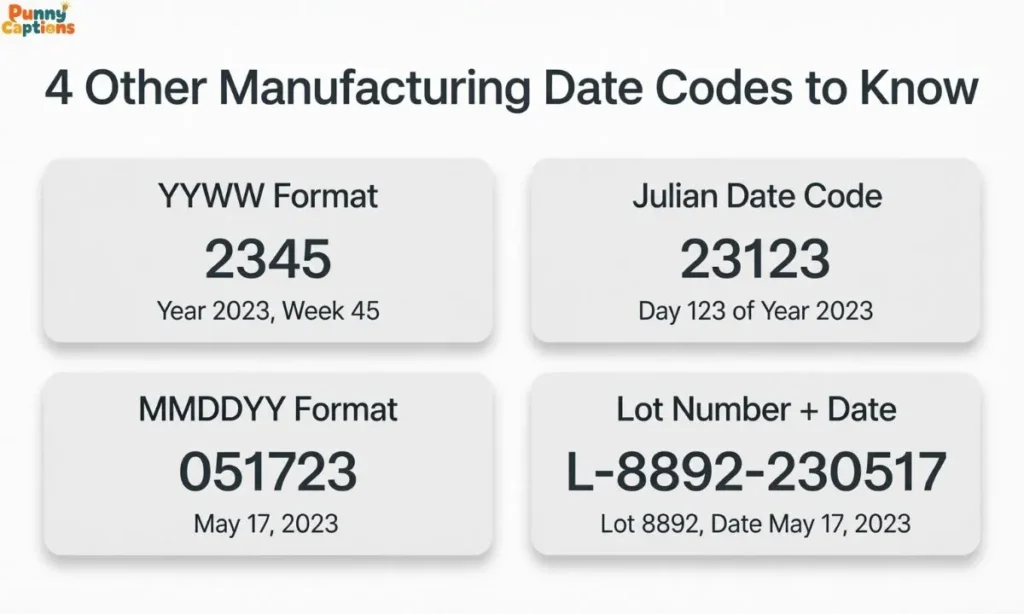
In addition to the MFG date, products regularly display four other types of date codes. Understanding each one ensures that you are interpreting product labels accurately and not confusing one code for another.
Packaging Date
The packaging date refers to the date on which a product was sealed into its final consumer packaging. In many cases, especially in large-scale food manufacturing, a product may be produced in bulk and held in storage before being packaged for retail distribution. As a result, the packaging date may be days, weeks, or even months after the manufacturing date.
For most consumer goods, the packaging date and manufacturing date are the same or very close. However, for bulk agricultural products, frozen goods, or processed meats, there can be a notable gap. Understanding this distinction helps consumers evaluate freshness more precisely, especially when dealing with products that have long supply chains.
Expiration Date
The expiration date is perhaps the most widely recognized date code. It represents the last date on which a manufacturer guarantees the product is safe and effective for its intended use. After the expiration date, a product may pose health risks, especially in the case of medications, dairy products, or perishable foods.
It is critical to understand that the expiration date is calculated from the MFG date. Manufacturers determine shelf life through stability testing, and the expiration date is set accordingly. This means that a product’s expiration date is inherently dependent on its manufacturing date. If a product’s manufacturing date has been tampered with or misprinted, the expiration date is rendered meaningless.
Best Before Date
The best-before date is commonly misunderstood as an expiration date, but it is not the same thing. The best-before date indicates the period during which a product will be at its peak quality — in terms of flavor, texture, appearance, or nutritional value. After the best-before date has passed, the product may still be safe to consume, but its quality may have declined.
Best-before dates are commonly found on canned goods, dry pasta, cereals, snack foods, and some beverages. They are a guide to quality, not safety. That said, consumers should exercise judgment. A product that is significantly past its best-before date — particularly one that shows visible signs of spoilage — should be discarded regardless of whether it is technically “safe.”
Use-By Date
The use-by date is stricter than the best-before date and is used for products that carry a more significant safety risk as they age. It is commonly found on fresh meats, ready-to-eat meals, soft cheeses, and certain dairy products. The use-by date indicates the last date on which a product should be consumed for safety reasons.
Unlike the best-before date, the use-by date should be treated as a firm deadline. Consuming products past their use-by date — particularly those requiring refrigeration — carries the risk of foodborne illness. Health authorities universally advise against using products beyond their stated use-by date.
How to Decode MFG Dates
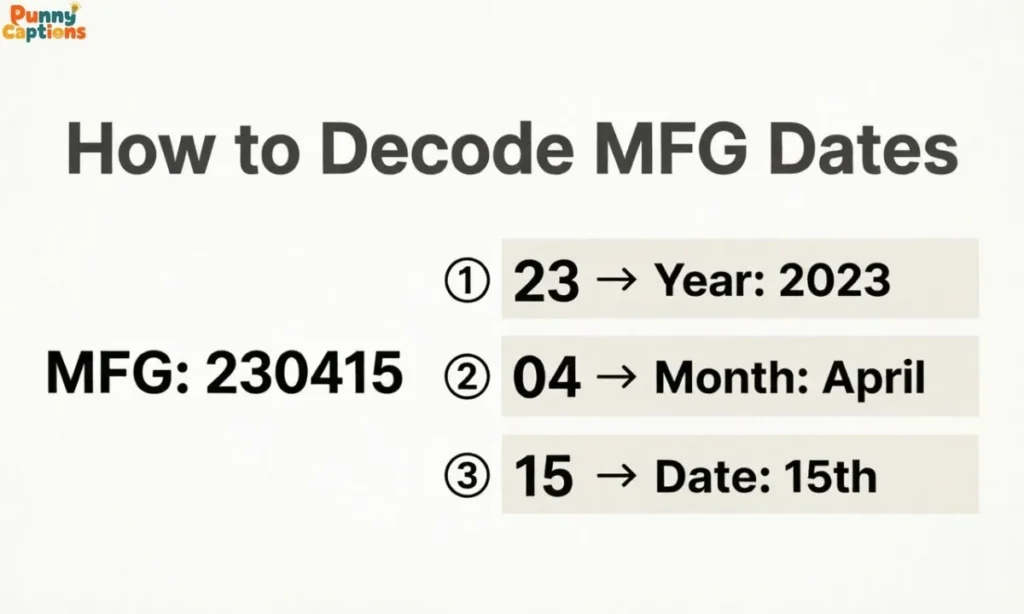
Decoding MFG dates can be challenging when manufacturers use non-standard or proprietary formats. The following strategies can help:
Step 1: Identify the label. Look for “MFG,” “Mfd.,” “Date of Manufacture,” or similar text near the printed code. This distinguishes it from other date codes on the same package.
Step 2: Determine the format. Consider the country of origin. American products typically use MM/DD/YYYY, while European and Asian products often use DD/MM/YYYY or ISO format. If the date includes only numbers with no slashes or hyphens, it may be a Julian date or a proprietary code.
Step 3: Look up Julian dates if necessary. If you see a five-digit number, it is likely a Julian date. The first two digits represent the year, and the last three represent the day of the year. For example, 26049 would be the 49th day of 2026, which is February 18, 2026.
Step 4: Contact the manufacturer for proprietary codes. Some manufacturers — particularly in the pharmaceutical and cosmetics industries — use encrypted or coded date formats for anti-counterfeiting purposes. In these cases, the manufacturer’s customer service line or website typically offers a decoding tool or explanation.
Step 5: Cross-reference with batch numbers. The MFG date is almost always accompanied by a batch or lot number. If you are uncertain about a product’s manufacturing date, the batch number can be used to verify the date directly with the manufacturer or relevant regulatory authority.
Caution: Don’t Use Medicine and Supplements with Old MFG Dates
Of all the product categories in which MFG dates matter, medicines and dietary supplements require the greatest caution. Unlike food products — where past-date consumption may merely result in a decline in taste or texture — consuming outdated pharmaceutical or supplement products can have serious health consequences.
Why potency declines over time: Active pharmaceutical ingredients (APIs) and the active compounds in dietary supplements are chemically unstable. Over time, they degrade — a process accelerated by exposure to heat, light, moisture, and air. A medication manufactured several years ago may contain significantly less active ingredient than its label claims, rendering it ineffective. In some cases, degradation can produce harmful by-products.
The specific risks of old medications: Certain medications are particularly vulnerable to age-related degradation. Liquid antibiotics, for example, can become not only ineffective but potentially toxic after their expiration. Insulin, nitroglycerin, and epinephrine (such as in EpiPens) are time-sensitive medications where sub-potency can be life-threatening. Eye drops and topical creams can become contaminated with microorganisms over time, especially once opened.
Supplements are not exempt: Many consumers assume that because vitamins and supplements are “natural,” they are less susceptible to deterioration. This is incorrect. Fat-soluble vitamins such as A, D, E, and K, as well as omega-3 fatty acids and probiotics, are highly susceptible to oxidation and microbial growth. A probiotic supplement with an old MFG date may contain far fewer live organisms than claimed on the label, making it essentially useless.
Practical guidance:
- Always check the MFG date on medications and supplements before purchasing. Avoid products manufactured more than 12 to 18 months ago, even if they have not yet reached their expiration date.
- Store medicines and supplements as directed — typically in a cool, dry place away from direct sunlight. Improper storage accelerates degradation regardless of the MFG date.
- Do not use any medicine or supplement that has passed its expiration date, even if it looks and smells normal. Degradation is often invisible to the naked eye.
- If you are unsure whether a medication is still safe and effective, consult a licensed pharmacist before use.
- Dispose of old medications safely through designated pharmaceutical disposal programs rather than flushing them or discarding them in household waste.
Also Read This: Woodpecker Spiritual Meaning
Frequently Asked Questions
What is the difference between MFG vs. EXP?
MFG shows when a product was made, while EXP tells the last safe date to use it.
Which is more important, MFG or EXP?
EXP is more important for safety, but MFG helps you know how old the product is.
Can I use a product after the EXP date?
It is not recommended, as the product may be unsafe or lose its effectiveness.
Does MFG date affect product quality?
Yes, older products may lose freshness or strength over time.
What does EXP date mean on food items?
It shows the last date the food is safe to eat.
Is Best By the same as EXP date?
No, Best By is about quality, while EXP is about safety.
How can I check product freshness using MFG?
Compare the MFG date with the current date to see how old the product is.
Do all products have MFG and EXP dates?
Most food, medicine, and cosmetics have these dates, but not all items do.
Why do companies include MFG dates?
They include it to show production time and help track product batches.
Can medicines be used after EXP date?
No, expired medicines may not work properly and can be risky.
Conclusion
Understanding “MFG Date” helps you make better choices. It tells you when a product was made. This gives you an idea of its freshness. It is useful for food, medicine, and daily items.
Knowing the difference between MFG, EXP, and Best By is very important. EXP shows the safety limit. Best By shows the best quality time. MFG gives the starting point of the product’s life.
Always check these dates before buying or using anything. It helps you stay safe and avoid waste. You can choose fresher and better products. Small checks like this make a big difference.