


Shekinah Glory Meaning is often linked with divine light. Many describe it as bright and pure. It is seen as a sign of God’s presence. This idea appears in many spiritual teachings.
In simple words, Shekinah means “dwelling” or “resting.” It shows how God stays close to people. This makes the term very meaningful. It highlights a strong spiritual connection.
People believe Shekinah Glory can be felt in quiet moments. It may come during deep prayer or reflection. Some feel peace and warmth at that time. These feelings make the experience special.
In religious stories, Shekinah Glory is shown as a cloud or light. It guided and protected people. This made them feel safe and supported. It showed God was always near.
Today, the meaning is still important for many. It inspires faith and hope in daily life. People look for this presence in their hearts. It helps them stay strong and calm.
The Word Shekinah Is Not in the Bible, but the Description Is
One of the first things that surprises people when studying this topic is that the actual word “Shekinah” does not appear anywhere in the Bible — not in the Old Testament, and not in the New Testament.
Yet the reality it describes is woven throughout Scripture from Genesis to Revelation.
The word itself is extrabiblical, yet the truth it points to is unmistakably biblical.
The word “Shekinah” comes from the Hebrew root word shākan, meaning “to reside,” “to settle,” or “to permanently dwell.”
It is closely related to mishkan — the Hebrew word for “tabernacle,” the portable dwelling place God commanded Moses to build in the wilderness. The very structure God designed for worship was named after the same concept as His indwelling presence.
The term “Shekinah” was introduced by Jewish rabbis during the intertestamental era — the roughly four hundred years between the Old and New Testaments.
During this period, Jewish scholars wrote in a body of literature known as the Targums — Aramaic translations and paraphrases of the Hebrew Scriptures. The rabbis used “Shekinah” to describe God’s divine presence among His people without directly using His name.
So while the word does not appear in the biblical text, the description of the Shekinah — the visible, glorious presence of God — is richly documented throughout both Testaments.
“Shekinah Glory” is often interpreted as meaning “He caused to dwell.” It points to God’s sovereign and gracious choice to make His presence known to human beings.
It is not something humans manufacture. It is entirely God’s doing — a gift of His grace and love.
How Is Shekinah Glory Portrayed in the Bible?
The Bible portrays the Shekinah Glory through a variety of natural and supernatural phenomena.
Each manifestation communicates something specific about the nature and character of God. These physical expressions of His presence were not accidental — they were carefully chosen to reveal divine truth.
As a Cloud
One of the most recurring portrayals of the Shekinah Glory is through the image of a cloud.
This was not an ordinary weather phenomenon. It was a supernatural cloud carrying the very presence and majesty of God.
When Moses went up on Mount Sinai to receive the Law, the glory of the LORD settled on the mountain and the cloud covered it for six days (Exodus 24:16). The cloud communicated God’s holiness and set apart the sacred space where He would meet with Moses.
The cloud also appeared at the tent of meeting. Exodus 33:9 tells us that as Moses entered, the pillar of cloud would come down and stay at the entrance while God spoke with him.
The most dramatic cloud appearance came at the dedication of Solomon’s Temple. When the Ark of the Covenant was brought into the Most Holy Place, the cloud filled the temple so powerfully that the priests could not perform their service (1 Kings 8:10-11).
The Shekinah Glory literally stopped worship in its tracks.
As a Pillar of Smoke and Fire
During the Israelites’ wilderness journey, God made His presence known through smoke and fire.
The pillar of cloud by day and the pillar of fire by night were constant, visible reminders that God was with His people — guiding and protecting them (Exodus 13:21-22).
Neither the cloud nor the fire ever left its place in front of the people. God’s presence was continuous and unwavering.
Fire throughout Scripture is associated with the holiness and consuming power of God. It speaks of His purity, His judgment, and His passionate desire for His people.
As Fire and a Burning Bush
One of the most intimate encounters with the Shekinah Glory is Moses’ experience at the burning bush.
In Exodus 3:2, “the angel of the LORD appeared to him in flames of fire from within a bush. Moses saw that though the bush was on fire it did not burn up.”
This miraculous sight drew Moses closer. It was in this moment that God revealed His name and His purpose for Moses’ life.
The burning bush speaks powerfully of the Shekinah: God is present in the fire, His holiness is on display, and yet the thing He inhabits is not destroyed — it is transformed and set apart.
The prophet Zechariah also referenced God’s fiery presence: “And I myself will be a wall of fire around it, declares the LORD, and I will be its glory within” (Zechariah 2:5).
Where Is Shekinah Glory First Mentioned in the Bible?

The first biblical account of the Shekinah Glory appears in the book of Exodus.
After the ten plagues and the miraculous crossing of the Red Sea, the Israelites found themselves in the wilderness — free from Egypt but facing an uncertain journey through an unfamiliar land.
It was in this moment of vulnerability that God revealed His presence in a visible and undeniable way.
Exodus 13:20-22 records: “By day the LORD went ahead of them in a pillar of cloud to guide them on their way and by night in a pillar of fire to give them light, so that they could travel by day or night. Neither the pillar of cloud by day nor the pillar of fire by night left its place in front of the people.”
This first manifestation of the Shekinah reveals several truths about God’s character.
First, God goes before His people. He does not send them into the unknown alone — He leads from the front.
Second, God’s presence is practical. The cloud guided them during the day, and the fire gave them light at night. The Shekinah Glory was not merely symbolic; it was functionally useful.
Third, the constancy of the pillar speaks of God’s faithfulness. His presence was not intermittent or conditional — it was steadfast and reliable.
This first appearance sets the tone for everything that follows: God is present. God is leading. God is faithful.
Why Does God Not Appear as a Human in the Old Testament?
Many sincere seekers have wrestled with this question. If God desired to dwell among His people, why did He not simply appear to them in human form?
The answer lies in the vast gulf between the infinite holiness of God and the finite, fallen nature of humanity.
The Bible makes this clear through Moses’ own experience. When Moses asked to see God’s glory, God responded: “You cannot see my face, for no one may see me and live” (Exodus 33:20).
This was not a harsh refusal. It was a statement of reality. The fullness of God’s glory — His perfect holiness and overwhelming majesty — is simply more than the human body and soul can withstand in our fallen condition.
And yet, even in this limitation, God’s grace is evident.
He did not dismiss Moses’ request. Instead, He told Moses to stand in a cleft in a rock and allowed him to see His back — the trailing edge of His glory — after He had passed by (Exodus 33:21-23).
Even this partial glimpse was overwhelming. When Moses came down from the mountain, his face was radiant and the people were afraid to come near him (Exodus 34:29-30).
The Old Testament manifestations of the Shekinah — the cloud, the fire, the smoke — were acts of divine mercy and accommodation.
They were ways in which an infinitely holy God made His presence accessible to finite, sinful human beings without destroying them.
They were veiled glimpses of a glory too great for human eyes to behold directly.
What Else Does Shekinah Glory Refer To?
While the most dramatic aspects of Shekinah Glory involve the physical manifestations of God’s presence, the concept is broader than these phenomena alone.
Shekinah Glory also refers to the call to honor, reflect, and declare the glory of God among all peoples and in all areas of life.
The Psalmist declared, “The heavens declare the glory of God; the skies proclaim the work of his hands” (Psalm 19:1).
God’s glory is not confined to a cloud or a pillar of fire. It radiates through all of creation for those who have eyes to see it.
The call to declare God’s glory is also given to His people. In 1 Chronicles 16:24, the Scriptures command: “Declare his glory among the nations, his marvelous deeds among all peoples.”
Believers are not merely called to experience God’s presence — they are called to make it known. They are agents through whom His glory is broadcast to a world that needs to encounter the living God.
The Apostle Paul brings this truth into the New Testament with powerful clarity:
“For God, who said, ‘Let light shine out of darkness,’ made his light shine in our hearts to give us the light of the knowledge of God’s glory displayed in the face of Christ.” (2 Corinthians 4:6)
The same God who created light in the physical realm creates spiritual light in the hearts of believers. The purpose of that light is to reveal the knowledge of God’s glory through Christ.
This is a profound expansion of the Shekinah concept. God’s glory is no longer displayed only in clouds or fire or temples — it is displayed in the transformed hearts and lives of those who have encountered Jesus Christ.
Believers become bearers and reflectors of the Shekinah Glory.
Examples of Shekinah Glory in the New Testament
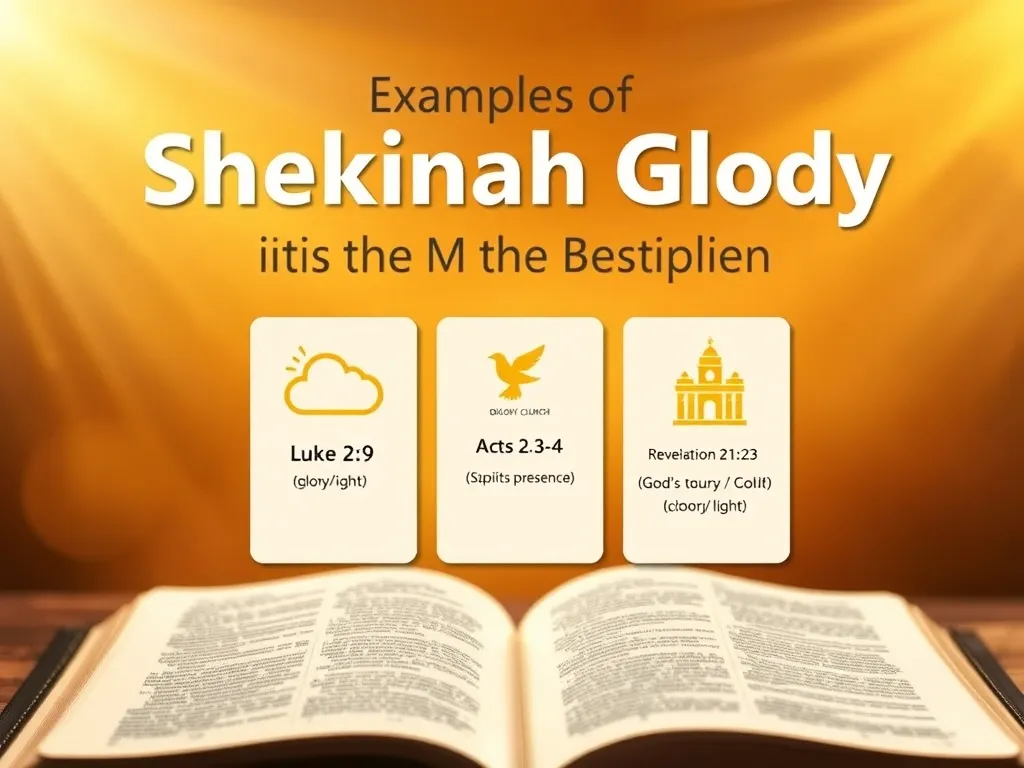
The Shekinah Glory does not disappear in the New Testament. Rather, it reaches its fullest and most intimate expression in the Gospels and the Epistles.
At the birth of Jesus, the shepherds in the fields outside Bethlehem experienced a direct encounter with the Shekinah.
“An angel of the Lord appeared to them, and the glory of the Lord shone around them, and they were terrified.” (Luke 2:9)
Their response — fear and trembling — mirrors the response of the Israelites whenever they encountered God’s glory in the wilderness. The same overwhelming, holy presence that once filled the Tabernacle was breaking into an ordinary night outside a small town.
The Transfiguration of Jesus is perhaps the most direct New Testament manifestation of the Shekinah. On the mountain, His face shone like the sun and His clothes became white as light (Matthew 17:2).
Then a bright cloud covered them, and a voice from the cloud declared: “This is my Son, whom I love; with him I am well pleased. Listen to him!” (Matthew 17:5)
The cloud of the Shekinah returned. This time it spoke not of the Law through Moses, but of the Son in whom all the fullness of God dwelt.
Paul describes the transformative effect of encountering God’s glory in 2 Corinthians 3:18:
“And we all, who with unveiled faces contemplate the Lord’s glory, are being transformed into his image with ever-increasing glory, which comes from the Lord, who is the Spirit.”
Unlike Moses, who had to veil his face after encountering God’s glory, believers in the New Covenant can gaze upon the Lord’s glory with unveiled faces.
As they do, they are progressively transformed — changed from one degree of glory to another. The Shekinah Glory is no longer observed from a distance; believers are being conformed to it.
The culmination is found in Revelation 21:3:
“Look! God’s dwelling place is now among the people, and he will dwell with them. They will be his people, and God himself will be with them and be their God.”
In the age to come, the Shekinah Glory will not be mediated through clouds or temples or veils. It will be the direct, unhindered, eternal presence of God with His people.
In the New Testament, Jesus Is the Manifestation of Shekinah Glory
If the Old Testament manifestations of the Shekinah were glimpses and shadows, then Jesus Christ is the full reality to which they all pointed.
In Jesus, the Shekinah Glory took on flesh and walked among us.
The Gospel of John opens with a stunning declaration:
“The Word became flesh and made his dwelling among us. We have seen his glory, the glory of the one and only Son, who came from the Father, full of grace and truth.” (John 1:14)
The phrase “made his dwelling among us” translates the Greek word eskēnōsen — which literally means “tabernacled” or “pitched his tent” among us. This is a direct allusion to the Tabernacle, the dwelling place of God’s Shekinah in the wilderness.
Paul makes the connection explicit in Colossians 2:9-10:
“For in Christ all the fullness of the Deity lives in bodily form, and in Christ you have been brought to fullness. He is the head over every power and authority.”
Every manifestation of God’s presence in the Old Testament — every cloud, every pillar of fire, every filling of the Temple — finds its ultimate fulfillment in Jesus Christ.
He is not merely a reflection of God’s glory. He is the fullness of the Deity dwelling in bodily form.
This is why Jesus could say, “Anyone who has seen me has seen the Father” (John 14:9).
When His disciples encountered Jesus — witnessed His miracles, heard His teachings, experienced His compassion — they were encountering the Shekinah Glory of God in its most intimate form.
The one who had spoken from within a burning bush and filled a Temple with His glory was now walking dusty roads in Galilee, touching lepers, raising the dead, and weeping at a friend’s tomb.
Jesus also fulfilled the role of the High Priest in a way no human priest ever could.
The author of Hebrews explains:
“For this reason he had to be made like them, fully human in every way, in order that he might become a merciful and faithful high priest in service to God, and that he might make atonement for the sins of the people.” (Hebrews 2:17)
In the Old Testament, the High Priest entered the Most Holy Place once a year to make a sacrifice for the people’s sins. Jesus fulfilled and surpassed this role — becoming both the High Priest and the sacrifice, offering not the blood of animals, but His own blood for the permanent forgiveness of sins.
Every miracle Jesus performed, every word He spoke, every act of healing and restoration was a revelation of the Shekinah — God’s presence made tangible, God’s glory made visible in the midst of human suffering and need.
Can We Experience Shekinah Glory Today?

This is perhaps the most personally significant question we can ask.
The cloud has lifted from the ancient Tabernacle. The Temple in Jerusalem has long since been destroyed. Is the Shekinah Glory something that belongs only to the past?
The resounding answer of Scripture is: No.
The Shekinah Glory is not a relic of history. For those who have placed their faith in Jesus Christ, the experience of God’s indwelling presence is not only possible — it is the defining reality of the Christian life.
The separation between God and humanity introduced by sin was decisively dealt with at the Cross of Calvary.
When Jesus died, something remarkable happened in the Temple:
“At that moment the curtain of the temple was torn in two from top to bottom.” (Matthew 27:51)
This curtain separated the outer courts from the Most Holy Place — the very dwelling of the Shekinah. Only the High Priest could pass through it, and only once a year.
When it was torn from top to bottom — from heaven downward — it signaled that the barrier between God and humanity had been removed. Access to the Shekinah Glory was now open to all who come through Jesus Christ.
Paul teaches that believers have become the new temple — the very dwelling place of God’s Spirit:
“Do you not know that your bodies are temples of the Holy Spirit, who is in you, whom you have received from God?” (1 Corinthians 6:19)
The same Spirit who filled the Tabernacle and the Temple now makes His dwelling in the hearts of every believer. The Shekinah has not departed — it has moved from a building made with human hands into human hearts.
Experiencing the Shekinah Glory today is not about traveling to a sacred place or performing a specific ritual.
It is about cultivating a living, personal relationship with the Holy Spirit who dwells within. Through prayer, Scripture, worship, community, and obedience, believers can experience the manifest presence of God in their daily lives.
There are moments in worship when the presence of God becomes almost tangible — when hearts are moved and the reality of God’s nearness becomes undeniable. These are Shekinah moments. They are genuine encounters with the God who has always desired to dwell among His people.
The ultimate promise lies ahead.
The book of Revelation assures us that a day is coming when the Shekinah Glory will be not occasional and partial, but constant and complete.
“They will see his face, and his name will be on their foreheads.” (Revelation 22:4)
What Moses was denied — the direct, unobstructed vision of God’s face — will be the eternal inheritance of all who are in Christ.
Until that day, we live as people of the Shekinah — carrying the divine presence within us, reflecting God’s glory to a dark world, and eagerly awaiting the day when His dwelling with us is not a future promise but an eternal reality.
Frequently Asked Questions
What is Shekinah Glory Meaning?
Shekinah Glory means the presence of God. It shows God is near to people.
What does Shekinah Glory represent?
It represents divine light, peace, and holiness. It is a sign of God’s power.
Is Shekinah Glory mentioned in the Bible?
The word itself is not directly in the Bible. But the idea of God’s presence is described many times.
Why is Shekinah Glory important?
It gives people comfort and faith. It reminds them that God is always near.
How can someone feel Shekinah Glory?
People feel it during prayer or worship. It comes as peace and calm in the heart.
What does Shekinah mean in simple words?
Shekinah means “dwelling” or “presence.” It shows God living among people.
Is Shekinah Glory a physical thing?
No, it is not physical. It is a spiritual feeling or experience.
Where did the term Shekinah come from?
It comes from Hebrew language and tradition. It has roots in ancient teachings.
Can Shekinah Glory be seen?
Some believe it appears as light or cloud. But most feel it spiritually, not physically.
What does Shekinah Glory teach us?
It teaches faith, hope, and trust in God. It helps people feel safe and guided.
Conclusion
Shekinah Glory reminds people of God’s close presence. It brings peace to the heart and mind. Many feel comfort when they think about it. This makes it a powerful spiritual idea.
It is not something we can see or hold. It is felt through faith and belief. People experience it in prayer and quiet moments. This makes their connection with God stronger.
In the end, Shekinah Glory stands for hope and light. It helps people stay calm in hard times. It reminds them they are never alone. This meaning keeps it special and meaningful.