


Nasik Fatafat is a fast lottery game that many people enjoy. It is popular because the results come very quickly. Players choose numbers and wait for the draw. The quick results make the game exciting and fun.
Many people like Nasik Fatafat because it has several draws in one day. This means players do not have to wait long for results. The fast pace keeps the excitement high. It also makes the game feel more thrilling.
Before playing, it is important to understand how the game works. Knowing the rules can help players avoid mistakes. People should also remember to play responsibly. Safe and careful play keeps the experience enjoyable.
What is Nasik Fatafat? A clear definition
Nasik Fatafat is a regional quick-draw number prediction game centred in and around Nashik (also spelled Nasik), Maharashtra. Players choose number combinations, place small bets with local agents or through online portals, and receive results within minutes through a series of draws spread across the day. The name itself captures its essence: ‘fatafat’ is a colloquial Hindi expression meaning ‘quickly’ or ‘instantly’.
The game belongs to a broader family of regional fatafat formats found across India — most famously Kolkata FF in West Bengal — that share the same DNA: rapid draw cycles, low entry costs, and a hyper-local social culture built around number sharing, lucky patterns, and agent networks. What distinguishes Nasik Fatafat is its roots in Nashik’s particular demographic mix of daily-wage workers, small traders, and working-class neighbourhoods where affordable entertainment with a shot at quick returns carries obvious appeal.
Several dedicated result-aggregation websites and local portals update Nasik Fatafat outcomes in near real time after each draw, reflecting just how embedded the game has become in the daily rhythm of the city.
How Nasik Fatafat works — rules, timing, and ticket types
The game’s staying power comes from its simplicity. There are no complicated rules, no elaborate betting structures, and no special equipment required. Here is how a typical Nasik Fatafat day unfolds.
Basic mechanics:
• Pick your number combination. Players choose from two- or three-digit combinations depending on the variant offered by the local agent or platform.
• Place your stake. Bets are deliberately small — often just pocket change — making the game accessible to players across income levels.
• Multiple draws per day. Most active portals and agent networks run six to eight draw slots from morning through evening. Each slot is independent.
• Collect your winnings. Small wins are typically paid in cash at the agent’s counter immediately after the draw. Larger prizes may require a visit to a regional claims point.
Typical draw schedule:
| Draw Slot | Approximate Timing (Local) | Notes |
| Morning Draw | ~10:00 – 10:30 AM | Early enthusiasm; lighter participation |
| Late Morning Draw | ~11:30 AM – 12:30 PM | Builds steadily through lunch |
| Midday Draws | ~1:00 PM – 2:30 PM | Peak activity; most players active |
| Afternoon Draws | ~4:00 PM – 6:00 PM | Social draw after work hours begin |
| Evening Draws | ~7:00 PM – 9:00 PM | Final rounds; higher-stake play common |
Ticket types and purchase channels:
• Local agents and kiosks. The oldest and most trusted purchase route. Agents collect bets in person and pay out winnings directly.
• Neighbourhood vendors and small shops. A step above the street-level agent; these operators often double as informal community hubs.
• Online portals and apps. A growing channel that allows number reservation and result tracking digitally. Licensing status varies widely — always verify before using one.
Why people play Nasik Fatafat — the psychology and social pull
No game sustains itself on mechanics alone. Nasik Fatafat has a powerful psychological and social architecture that keeps players returning draw after draw.
• Speed as a feature. The gap between placing a bet and seeing a result is measured in minutes, not days. That immediacy is a fundamentally different emotional experience from waiting a week for a lottery draw. Anticipation compresses; reward (or disappointment) arrives fast.
• Low-cost, high-frequency thrills. Because individual bets are small, players can participate repeatedly without large financial exposure per round — at least in theory. The affordability makes it feel low-risk.
• Social glue. Nasik Fatafat is rarely a solitary activity. Players gather at tea stalls and local shops, share their chosen numbers on WhatsApp groups, debate lucky patterns, and replay near-wins and surprise jackpots with friends. The game is conversation.
• The micro-hope economy. For many players in working-class neighbourhoods, Fatafat offers an affordable, daily-scale shot at luck. It does not require wealth to enter; it only requires belief that today might be different.
• Habit and routine. Over time, checking results after each draw becomes as habitual as checking messages. The rhythm of the game integrates itself into the day.
The problem is that the very features that make the game enjoyable — speed, frequency, small stakes — also create a compulsion loop. Quick results reinforce immediate re-engagement. Players who experience a small win want to try again immediately; players who lose want to recover quickly. Understanding this loop is essential to managing your own play habits.
The legal landscape: what’s permitted in Maharashtra and across India

India’s lottery and gaming regulation is primarily a state-level responsibility. Each state decides whether to permit lotteries, how to license operators, what formats are allowed, and how winnings are taxed. This decentralized structure creates a patchwork of permissions and prohibitions across the country.
Key legal realities for Nasik Fatafat players:
• Maharashtra’s lottery history. Maharashtra is among the Indian states that have historically permitted regulated lotteries under defined frameworks. State-run lotteries operate legally. However, private, unlicensed lottery-like games exist in a grey zone.
• The online complication. Web-based and app-based platforms that organize quick-draw betting raise distinct regulatory questions. Maharashtra and several other states have actively debated new legislation to bring online gaming and rapid-result platforms under tighter oversight. As of 2025, this remains a live regulatory discussion.
• Taxation of winnings. Lottery and gambling winnings are taxable under Indian law. Depending on the prize size, flat-rate tax deductions at source may apply, and recipients may need to report large winnings under the Income Tax Act. Both central and state tax rules can affect the net payout.
• What this means practically. If Nasik Fatafat operates through a state-licensed channel, it is legal and taxed accordingly. If it runs through an unlicensed vendor — street-level or online — players have no legal recourse in case of fraud, manipulated results, or refusal to pay. The operator also faces legal exposure. Always verify the licensing status of whoever is taking your money.
Real risks and harms — what to watch for
Fast-draw games look harmless from the outside. Small bets, quick results, a friendly agent — it feels casual. But the same features that make the game easy to enter also make its risks easy to underestimate. Here are the hazards that warrant serious attention:
• Chasing losses. Rapid results create the illusion that the next draw is a fresh opportunity to recover. Players who lose one round often bet again immediately. Without a fixed stop point, losses compound quickly across multiple draws in a single day.
• Unlicensed operators and fraud. Vendors without proper licensing can delay payouts indefinitely, manipulate draw results, or simply disappear with collected bets. The absence of regulatory oversight removes all normal consumer protections.
• Addiction risk. The frequency and speed of Fatafat draws makes it significantly more habit-forming than weekly lotteries. Players can develop compulsive patterns without recognizing the shift from entertainment to dependency.
• Underage access. Informal street-level agents rarely enforce age restrictions rigorously. Young people can enter the game without meaningful barriers.
• Household financial strain. Regular play, even at small individual stakes, adds up across a month. Families where multiple members participate can find a meaningful portion of household income directed toward Fatafat without realizing it.
• Regulatory disruption. Police action or sudden regulatory changes can freeze informal networks overnight, leaving players without recourse if money is tied up with a vendor at that moment.
Simple protective principle: any vendor who cannot show you a licence, offer a written receipt, or explain the claims process clearly carries elevated risk. Proceed with caution or not at all.
How to check Nasik Fatafat results reliably
Given that draws happen multiple times daily and that many unofficial sites populate the internet with Fatafat-related content, knowing how to access trustworthy results matters.
Trusted result channels:
• Official state portals (where available). State-run result pages are the most authoritative source. Their availability depends on whether the game operates under a formal state franchise.
• Established aggregator websites. Several dedicated platforms update Nasik Fatafat results within minutes of each draw. Look for sites that display consistent historical data, clear timestamps, and identifiable ownership or contact information.
• Local agents. A trusted neighbourhood agent will have the official result slip in hand shortly after each draw. For players with a reliable agent relationship, this is often the fastest and most dependable source.
• Community channels with verification. WhatsApp or Telegram groups can distribute results quickly, but always cross-check against at least one independent source before acting on the information — particularly for larger prize claims.
Quick verification checklist:
• Check that the site shows at least 7–14 days of historical results with consistent timestamps.
• Look for an identifiable owner, physical address, or verifiable contact.
• Cross-check any draw result across two sources before claiming a significant prize.
• Avoid any site that demands payment or personal information simply to view result data — this is a red flag.
Tips and rules to play Nasik Fatafat smartly
Playing Nasik Fatafat safely is entirely achievable if you approach it as entertainment with clear rules for yourself. These habits reduce harm and keep the experience enjoyable:
• Set a firm daily budget before you start. Decide what you are willing to spend across all draws for the day and treat that figure as the absolute ceiling — not a target.
• Keep winnings separate from your playing fund. If you win, move those earnings to a separate envelope or account rather than rolling them back into the next bet. This makes wins real and losses finite.
• Play with friends who share your limits. Social play is more fun, and agreeing on spend limits in advance creates mutual accountability.
• Use only licensed, verifiable vendors. Your choice of agent is the single most important risk-mitigation decision you make.
• Never borrow to play. Using credit or loans to fund Fatafat bets is a clear signal that the game has shifted from entertainment to problem.
• Always get a receipt. A written acknowledgment for both your bet and any payout is your only documentation if a dispute arises.
• Walk away on time. Set a draw limit per day, not just a money limit. Deciding in advance that you will play only the morning and midday rounds prevents the escalation that evening draws often bring.
Short rule to keep in your pocket: Bet small. Verify always. Stop when you planned to stop.
Table: Nasik Fatafat vs State-Run Lotteries — a quick comparison
| Feature | Nasik Fatafat (Quick-Draw) | State-Run Lottery |
| Draw frequency | 6–8 draws per day | Usually 1 per day or per week |
| Minimum stake | Very low (pocket change) | Variable; often higher minimums |
| Result speed | Minutes after each draw | Scheduled; longer wait |
| Regulation clarity | Varies — grey zone common | Typically licensed and regulated |
| Payout method | Cash via agent (small wins) | Formal claims process |
| Online presence | Unofficial aggregator sites | Official state portals available |
| Fraud risk | Higher if unlicensed | Lower if state-licensed |
| Social culture | Strong; local agent networks | Less community-embedded |
Case study (composite, anonymized): A cautionary near-win
The following account is composite — constructed from patterns, experiences, and outcomes commonly reported across local player forums, community discussions, and consumer complaint records. All identifying details have been changed to protect privacy.
Deepak is a small hardware store owner in a working-class neighbourhood of Nashik. He plays Nasik Fatafat casually — a couple of rounds in the morning before opening the shop, maybe one in the evening. His usual agent is someone he has known for years, and small payouts have always come through without trouble.
One afternoon, Deepak chose a number combination based on a sequence a relative had mentioned. He staked slightly more than usual, felt good about his choice, and waited for the evening draw. The result portal his agent used showed his number as the winning combination. His potential payout exceeded the cash the agent typically kept on hand.
The agent asked Deepak to return the next day; the ‘regional office’ needed to process the payout. Days passed. Each visit brought a new excuse — paperwork delays, an officer being unavailable, a system issue. When Deepak asked for written documentation confirming his win and the pending payout, the agent grew evasive. After two weeks of frustration, Deepak contacted a local consumer rights group. With witnesses and his original bet receipt, he eventually recovered a partial amount — but not the full prize, and never with any formal acknowledgment of the shortfall.
What Deepak learned:
• An immediate small-win payout from a trusted agent is reliable. A large-prize payout routed through a ‘regional office’ without documentation is a warning sign.
• Always demand written confirmation — the amount won, the draw date, the expected payout date — before leaving any significant prize uncollected.
• Keep your bet receipt. Without it, you have no proof of participation.
• If delays exceed 48 hours without written explanation, escalate immediately to consumer authorities.
Community behaviour and cultural patterns — how the game lives locally

Nasik Fatafat is not just a game; it is a social institution in the neighbourhoods where it thrives. Understanding its cultural embedding explains both its resilience and some of its risks.
• The tea stall as a result hub. In many Nashik localities, the draw result arrives at the neighbourhood tea stall almost simultaneously with agent notifications. Players gather, numbers are announced, wins are celebrated with small gestures, and losses are dismissed with philosophical shrugs. The stall becomes a kind of community notice board.
• WhatsApp networks and number culture. Players share ‘patti’ — favoured number patterns — through messaging groups with remarkable seriousness. Old charts are studied like historical data. Patterns from previous draws are analysed for trends. The community generates its own informal expertise.
• Personal rituals and lucky numbers. Birth dates, wedding anniversaries, house numbers, and dream-derived combinations are all treated as legitimate inputs. These rituals give the game personal meaning that pure probability cannot explain — and they bind players emotionally to the outcome.
• Agent livelihoods. For local agents and vendors, Fatafat is income. Their network of relationships — with players, with results distributors, with payout chains — represents real economic activity. When regulation tightens, it does not just affect players; it disrupts livelihoods embedded in local economies.
• Cross-generational transmission. Older family members introduce younger ones to the game as a cultural touchpoint. That familiarity reduces perceived risk — and sometimes lowers the guard against the game’s more serious downsides.
Responsible play and help resources
If you find yourself — or someone you care about — playing beyond comfortable limits, early action is always better than delayed intervention. These steps provide practical support:
• Create friction for yourself. Delete result app shortcuts. Remove vendor contacts from easy-reach positions in your phone. Make participating slightly harder to start.
• Pre-commit to cash only. Bring only your pre-decided daily budget in cash. Leave cards and extra cash at home. Removing access prevents impulsive decisions.
• Have an honest conversation. Talk to a trusted family member or friend about your play habits. External accountability makes limits more durable.
• Seek professional support. Local financial counselling centres, NGOs focused on debt and gambling harms, and community health workers in Maharashtra can provide confidential guidance.
• Report fraud promptly. If an agent refuses payout, delays unreasonably, or behaves evasively: keep every receipt and screenshot, note dates and conversations, and file a complaint with local police and relevant consumer protection authorities.
Maharashtra has publicly discussed stronger consumer protections and clearer regulatory frameworks for online gaming and lottery-like platforms through 2024 and 2025. These discussions signal that the state recognizes the need for better safeguards — and that players who face problems have a growing institutional framework to appeal to.
How Nasik Fatafat fits into India’s broader lottery and gaming scene
To understand Nasik Fatafat fully, it helps to see it within India’s wider regulatory landscape — a patchwork that reflects the country’s federal structure and its ongoing struggle to define where entertainment ends and harm begins.
India’s lottery map:
• States like Kerala, Sikkim, Goa, Maharashtra, and a handful of others permit state-run or regulated lotteries.
• States like Tamil Nadu, Gujarat, and others prohibit lotteries outright.
• Online gaming platforms operate across state lines, creating jurisdictional challenges for regulators.
Where Fatafat sits in this picture:
• Regional informal games. Nasik Fatafat belongs to a category of regionally embedded, fast-draw games that exist somewhere between licensed state lotteries and illegal private gambling. The informal ones operate in grey zones that regulators have not yet fully addressed.
• Technology is reshaping the landscape. Mobile result apps and aggregator websites are collapsing the distinction between local informal play and online gambling. Regulators are increasingly aware that the same consumer protection issues that apply to apps apply to street-level agents connected to digital networks.
• Tax enforcement is tightening. As more lottery-like activity leaves a digital trail, tax authorities have greater visibility into winnings. Players who receive significant payouts should expect greater reporting requirements in the years ahead.
• A regulatory direction is emerging. Multiple states, including Maharashtra, have signalled intent to create clearer licensing frameworks for online and quick-draw gaming. What this means in practice — for vendors, for players, for the cultural networks around games like Fatafat — is still taking shape.
Practical checklist before you play Nasik Fatafat
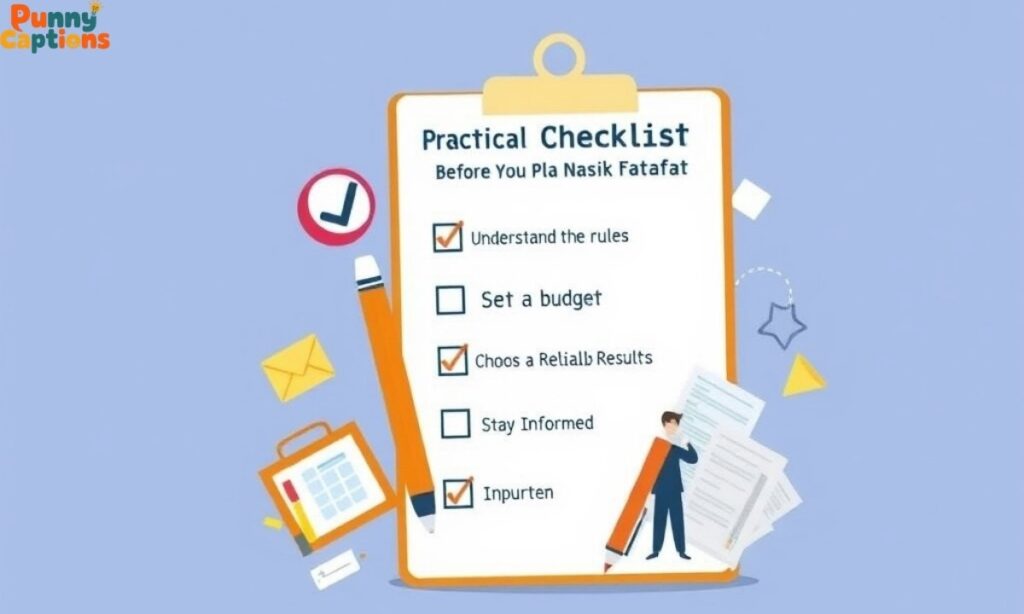
Before placing your first bet of the day, run through this checklist:
1. Confirm your vendor’s identity and whether they reference a valid state licence.
2. Decide your spending cap for the day before placing any bet — and write it down.
3. Get a written or printed receipt for every bet you place.
4. Identify at least two trustworthy result sources you will use to verify any win before claiming.
5. Decide in advance which draw rounds you will play and which you will skip — and stick to that plan.
6. Treat any win as a windfall to be set aside, not as fuel for immediate re-investment.
7. If a payout is delayed beyond 24–48 hours without written explanation, escalate immediately and document every interaction.
Quotes from the field
“The game brings the neighbourhood together. We argue about numbers, celebrate small wins, commiserate over losses. But I always tell the younger ones: it is entertainment money, not savings money.”
“The speed is what gets people. Weekly lotteries you buy and forget. Fatafat you buy and you are already thinking about the result twenty minutes later. That is a very different relationship with money.”
“We have seen families where three members play across every draw. They do not think of it as one budget; they think of it as three separate small bets. But it adds up to something real by month end.”
The future of Nasik Fatafat — likely scenarios
Regional quick-draw games like Nasik Fatafat are at an inflection point. Several forces are converging to reshape what the game looks like in the next two to five years.
• Regulatory formalization. Maharashtra and other states are moving toward clearer licensing frameworks for online gaming and quick-result platforms. If Fatafat-style games are brought under formal regulation, players gain consumer protections they do not currently have — but the informal networks that give the game its local character may be significantly disrupted.
• Digital standardization. Formalized regulation would likely bring mandatory digital result publication, standardized claim procedures, verified vendor registrations, and auditable draw mechanisms. This would reduce fraud substantially but may also reduce the spontaneous, community-run nature of the game.
• Tax clarity and enforcement. As digital transaction trails become more visible to tax authorities, reporting requirements for lottery-like winnings will almost certainly tighten. Players who receive significant payouts should be prepared for clearer withholding and reporting rules.
• Continued informal persistence. Even in a more regulated environment, informal Fatafat play will likely continue in rural and semi-urban communities where cash, personal trust, and established habits dominate. Regulation typically reaches urban centres first; its reach into smaller localities lags.
• Technology-driven expansion. If regulated, app-based Fatafat platforms could expand access significantly — with real-time results, verified vendor directories, and digital payout systems. This could formalize and grow the player base while reducing the grey-zone risks that currently exist.
Closing: quick summary and a final word of advice
Nasik Fatafat is a genuinely distinctive part of Nashik’s social and cultural landscape. Its speed, affordability, and community dimension give it an appeal that more formal, impersonal lottery formats simply cannot replicate. For players who approach it with clear eyes and firm limits, it delivers what it promises: a quick, affordable, social thrill.
The risks are equally real. The same features that make the game exciting — fast results, frequent draws, low entry points — create the conditions for compulsive play, financial strain, and exploitation by unlicensed operators. Neither dimension of this reality deserves to be minimized.
If you take one principle from this guide, let it be this: the quality of your Fatafat experience depends almost entirely on decisions you make before you place your first bet of the day — your vendor choice, your spending cap, your planned stop point. Make those decisions when you are calm and clear, and stick to them when you are in the middle of the game.
Play smart. Verify everything. Protect your money. And keep the lucky moments exactly what they should be: small, joyful, and fully under your control.
Sources and further reading
• Nasik Fatafat daily result pages and established aggregator portals tracking draw outcomes across the day.
• Overview guides to Fatafat game formats and how-to-play resources for regional quick-draw lotteries in India.
• Legal and regulatory context: state lottery laws in India, Maharashtra gaming regulation frameworks, and recent legislative discussions on online gaming.
• Maharashtra government deliberations on online gaming oversight and proposed regulatory reforms (2024–2025).
• Indian Income Tax Act provisions applicable to lottery winnings and gambling income.
• Consumer protection authority resources for reporting vendor fraud or disputed payouts in Maharashtra.
Frequently Asked Questions
What is Nasik Fatafat?
Nasik Fatafat is a fast lottery-style number game. Players choose numbers and wait for quick draw results.
How does Nasik Fatafat work?
In Nasik Fatafat, players select numbers and the system announces results multiple times a day. Winners are based on matching the drawn numbers.
Is Nasik Fatafat legal to play?
The legality of Nasik Fatafat depends on the region or country. Players should always check local laws before participating.
How can I play Nasik Fatafat safely?
You should set a spending limit and treat it only as entertainment. Avoid risking money you cannot afford to lose.
How many draws happen in Nasik Fatafat daily?
Nasik Fatafat usually has many draws throughout the day. This makes the game fast and exciting for players.
Where can I check Nasik Fatafat results?
Results are often shared on lottery result websites or local agents. Some platforms also provide updates online.
Why is Nasik Fatafat so popular?
Its fast results and simple gameplay attract many players. People enjoy the quick excitement and frequent draws.
Can beginners play Nasik Fatafat easily?
Yes, beginners can understand the game quickly because the rules are simple. It mainly involves choosing numbers and waiting for results.
Is Nasik Fatafat based on luck or skill?
Nasik Fatafat is mostly based on luck. The numbers are drawn randomly, so no strategy guarantees a win.
What should players remember before playing Nasik Fatafat?
Players should play responsibly and understand the risks. It is best to treat the game as fun entertainment.
Conclusion
Nasik Fatafat is a fast and thrilling lottery game that attracts many players. Its quick results make the game exciting and full of suspense. The simple format allows people to understand it easily. This is why many players enjoy trying their luck.
Learning how the game works is an important step before playing. When players know the rules, they can avoid confusion. It also helps them enjoy the game in a better way. Knowledge makes the experience more fun and smooth.
At the same time, responsible play is very important. People should always set limits and play carefully. It should be seen as entertainment, not a way to earn money. Playing safely helps keep the experience enjoyable for everyone.