


LEQ Meaning is a short word that many people see online. It is often used in messages and social media posts. The meaning can change depending on the context. That is why many people search to understand what Leq really means.
Sometimes people use Leq in texting or casual conversations. It can appear in captions, comments, or chats. Many young users use short forms like this. These words make online communication faster and easier.
In this guide, you will learn the simple meaning of Leq. We will also look at how people use it online. You will see examples in different situations. This will help you understand the word clearly.
What Does LEQ Mean?

LEQ stands for Long Essay Question. It is one of the major written components of AP history exams, including APUSH (AP United States History), AP World History, and AP European History. The LEQ is designed to assess your ability to construct a well-organized, evidence-based historical argument in response to a broad prompt.
In simple terms, the LEQ is an essay question — but not just any essay. It demands critical thinking, historical reasoning, and strong writing skills. The College Board uses the LEQ to evaluate how well students can analyze historical developments, make arguments, and support their claims with specific evidence.
LEQ Meaning in APUSH
In APUSH (AP United States History), the LEQ is one of three free-response questions on the exam. Students are given a choice between two or three essay prompts and must write a response to one of them. The LEQ in APUSH accounts for 15% of your total exam score, making it a significant part of your final grade.
The APUSH LEQ typically asks you to:
- Analyze causes and effects of a historical development
- Compare two time periods, regions, or movements
- Evaluate change and continuity over time (CCOT)
- Assess the significance of a historical event or trend
You will have approximately 40 minutes to plan and write your LEQ during the exam. While that may sound like a lot, writing a strong, cohesive essay in that time requires preparation and practice.
LEQ Meaning in AP History (World, European, and More)
The LEQ is not exclusive to APUSH. It appears across multiple AP history courses offered by the College Board. Here is how the LEQ fits into each:
AP World History (APWH)
In AP World History: Modern, the LEQ is also worth 15% of your score. The prompts here focus on global developments across different civilizations, trade networks, empire-building, and cultural exchange. Students choose from three prompts, each tied to a different time period covered in the course.
AP European History (APEH)
In AP European History, the LEQ follows the same structure as in APUSH. Students write an argumentative essay in response to a historical prompt covering events, trends, and figures from European history. Again, this section is worth 15% of the overall score.
LEQ vs DBQ: What Is the Difference?
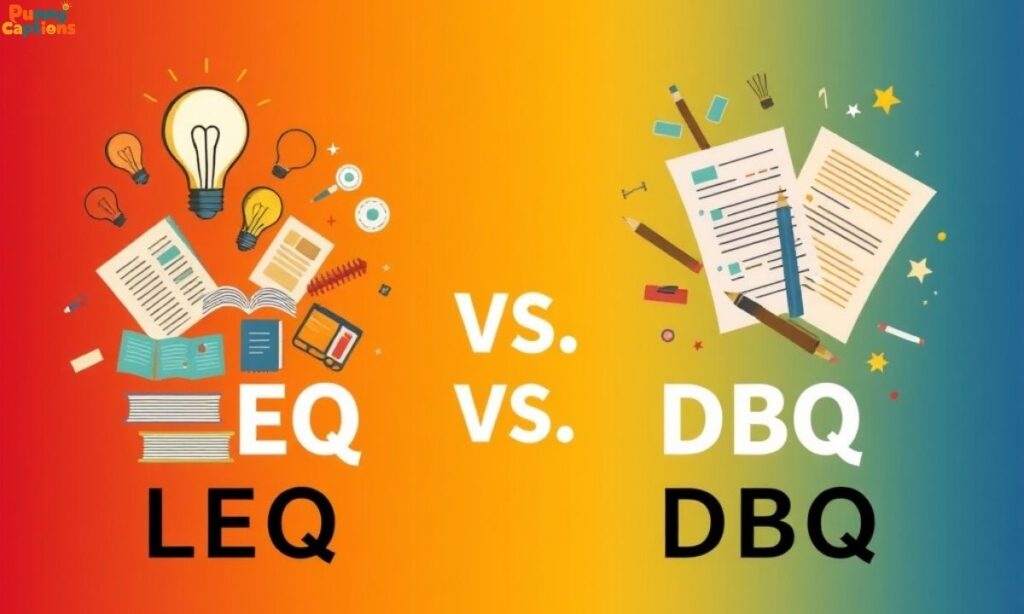
Many students confuse the LEQ with the DBQ (Document-Based Question). While both are essay formats used in AP history exams, they are fundamentally different.
- The DBQ provides a set of primary and secondary source documents. Your job is to analyze those documents and use them as evidence to support your argument.
- The LEQ provides NO documents. You must rely entirely on your own knowledge of history to support your argument.
This is why the LEQ is often considered more challenging for some students — it tests the depth and breadth of your historical knowledge without any scaffolding from provided sources.
How Is the LEQ Scored? The LEQ Rubric Explained
The College Board scores the LEQ on a scale of 0 to 6 points. Understanding the rubric is essential for maximizing your score. Here is a breakdown of the LEQ rubric:
1. Thesis / Claim (1 point)
To earn this point, your essay must have a historically defensible thesis that makes a claim responding directly to the prompt. Your thesis must go beyond simply restating the prompt — it must make an argument. Typically, your thesis should appear in the introduction or conclusion paragraph.
2. Contextualization (1 point)
Contextualization means accurately describing a broader historical context that is relevant to the prompt. This is more than just mentioning background information — you must explain how that context relates to the argument you are making. This typically appears in your introductory paragraph and should consist of multiple sentences.
3. Evidence (up to 2 points)
You can earn up to 2 points for evidence. The first point is awarded for providing specific examples relevant to the topic. The second, harder-to-earn point requires you to use that specific evidence to support your argument — not just list it.
4. Analysis and Reasoning (up to 2 points)
These points reward higher-order historical thinking. You can earn one point by demonstrating a historical reasoning skill such as causation, comparison, or continuity and change over time (CCOT). A second point is available if you demonstrate a complex understanding of the historical development — for example, by explaining multiple causes, considering both similarities and differences, or acknowledging limitations to your argument.
How to Write a Strong LEQ: Step-by-Step Guide
Now that you understand what the LEQ is and how it is scored, let us walk through the process of writing a strong one.
Step 1: Analyze the Prompt (5 minutes)
Before writing a single word of your essay, take time to carefully read and analyze the prompt. Identify the key historical period, the topic being asked about, and the type of reasoning required (causation, comparison, CCOT, etc.). Underline key words and think about what argument you want to make.
Step 2: Brainstorm and Outline (5–7 minutes)
Spend a few minutes jotting down everything you know about the topic. Identify the specific evidence you will use and think about how it supports your argument. Create a brief outline that maps out your thesis, context paragraph, body paragraphs, and conclusion.
Step 3: Write a Strong Thesis
Your thesis is the most important sentence in your LEQ. It must make a historically defensible claim that directly addresses the prompt. A strong thesis does not just answer “yes” or “no” — it explains how and why, and ideally previews the categories of analysis you will use in your body paragraphs.
Step 4: Establish Context
Your introduction should open with contextualization — a few sentences describing the broader historical situation before or around the period in the prompt. Then connect that context to your thesis, showing how it is relevant to your argument.
Step 5: Write Body Paragraphs with Evidence
Each body paragraph should open with a topic sentence that supports your thesis, present at least one or two specific pieces of evidence, and explain how that evidence supports your argument. Do not just state facts — analyze them. Ask yourself: “So what? Why does this matter to my argument?”
Step 6: Demonstrate Complex Understanding
To earn the complexity point — the hardest point on the rubric — you need to go beyond surface-level analysis. Consider including a counterargument, discussing a turning point, making connections across time periods, or examining how different groups were affected differently by the historical development.
Step 7: Write a Conclusion
Your conclusion should restate your thesis in different words and briefly summarize your argument. Note that you can also place your thesis in the conclusion if it does not appear in the introduction, though most teachers and test-prep experts recommend putting it in the intro.
Common LEQ Mistakes to Avoid

Even well-prepared students make avoidable mistakes on the LEQ. Here are the most common pitfalls:
- Writing a thesis that simply restates the prompt without making an argument
- Confusing contextualization with a basic introduction — context must connect meaningfully to your thesis
- Listing facts without analyzing them or tying them back to your argument
- Failing to demonstrate the required historical reasoning skill (causation, comparison, or CCOT)
- Running out of time because too little planning was done before writing
- Ignoring the complexity point by playing it too safe and not demonstrating nuanced thinking
LEQ Example Prompt and Response Breakdown
To make all of this concrete, let us look at how a student might approach a sample APUSH LEQ prompt.
Sample Prompt: “Evaluate the extent to which the Civil War transformed American society in the period 1860 to 1900.”
Contextualization:
Introduce the sectional tensions that built throughout the antebellum period — the debates over slavery’s expansion, the failures of political compromise, and the growing economic divide between North and South. Connect this to why the Civil War resulted in such profound transformations.
Thesis:
While the Civil War brought significant legal and political transformations — especially for African Americans through the 13th, 14th, and 15th Amendments — the incomplete nature of Reconstruction and the rise of Jim Crow laws limited the extent of social change, revealing both the promise and the failure of postwar reform.
Body Paragraphs:
- Paragraph 1: The legal abolition of slavery and constitutional amendments as transformative changes
- Paragraph 2: The political reorganization of the South during Reconstruction, including Black political participation
- Paragraph 3: The limitations — Black Codes, Compromise of 1877, sharecropping, and the emergence of the Jim Crow system
Tips for Earning a 6/6 on the LEQ

Here are actionable tips to help you maximize your LEQ score:
- Practice writing LEQs under timed conditions. Use past AP exam prompts from the College Board website.
- Memorize the rubric. Know exactly what is being assessed and write with the rubric in mind.
- Build a mental bank of specific historical evidence organized by time period and theme.
- Practice your contextualization. Many students lose this easy point by writing generic introductions.
- Study complexity strategies — learn how to make an argument that acknowledges counterarguments, nuance, or change over time.
Frequently Asked Questions
What is the Leq meaning in texting?
Leq in texting usually has different meanings depending on the conversation. People often use it as a short or slang word online.
What does Leq mean on social media?
On social media, Leq can appear in captions or comments. Its meaning depends on the context of the message.
Is Leq a slang word?
Yes, Leq is often treated as an internet slang. Many users use short words like this in chats and posts.
What is the full form of Leq?
Leq does not always have one fixed full form. Its meaning can change based on how people use it online.
Why do people use Leq online?
People use Leq to keep messages short and quick. It is common in casual texting and social media.
Is Leq meaning different in different contexts?
Yes, the meaning of Leq can change depending on the situation. Context helps you understand its real meaning.
Can Leq be used in Instagram captions?
Yes, some people use Leq in captions or comments. It can add a casual or trendy tone to posts.
How do you understand the correct Leq meaning?
The best way is to read the full sentence or conversation. Context usually explains the real meaning.
Is Leq popular on the internet?
Leq is not as common as other slang words. But it still appears in some online conversations.
Where is Leq mostly used?
Leq is mostly used in online chats, comments, and social media posts. It is part of modern internet language.
Conclusion
Leq is a short word that people use in different ways online. Its meaning depends on the situation and conversation. Many internet users like using short words in chats. It makes communication quick and simple.
Understanding the meaning of Leq helps you follow online conversations better. You may see it in captions, comments, or messages. Knowing the context is very important. This helps you understand what the person really means.
The list of best Leq meanings gives many examples to explore. You can use them for social media or texting. These ideas can make your messages more interesting. Simple words can still share strong feelings and thoughts.