
Understanding Hold Fast meaning is simple and useful. It is a short phrase with deep power. People use it in many life situations. It gives strength and encouragement.
The words “hold” and “fast” together mean stay firm. They tell someone not to give up. This phrase has been used for many years. It still feels strong and meaningful today.
In daily life, people use it for support. It can relate to faith, love, or goals. The message is about staying strong in hard times. That is why its meaning and relevance still matter.
What Does “Hold Fast” Mean?
- “Hold fast” means to grip tightly and refuse to let go, no matter what force tries to pull you away.
- It is a command to stay firm in your beliefs, values, or position even when pressure mounts.
- At its core, “hold fast” is a declaration that you will not be moved by circumstance.
- The phrase carries the weight of stubborn, intentional, unwavering commitment.
- “Hold fast” means to anchor yourself to what matters most and refuse to drift.
- It is both a nautical command and a life philosophy wrapped in two powerful words.
- To hold fast is to choose steadiness when everything around you is shifting.
- The phrase means to maintain your grip on truth, faith, or purpose with both hands.
- “Hold fast” is what you say — and what you do — when letting go is not an option.
- It means staying loyal to your course even when the storm makes turning back tempting.
- To hold fast is to resist every force that tries to separate you from what you believe.
- The phrase is a quiet act of defiance against doubt, fear, and surrender.
- “Hold fast” means more than survival — it means holding your shape through adversity.
- It is the two-word instruction manual for endurance.
- To hold fast is to be the one thing in the room that does not bend.
- The phrase means: grip harder when things get harder.
- “Hold fast” is the language of those who refuse to abandon their post.
- It means to cling to what is true, good, and worth protecting.
- To hold fast is to make a promise to yourself that you will still be standing when it passes.
- The phrase says: the storm is real, but so is my grip.
- “Hold fast” is the instruction given before things get difficult — and the reminder during.
- It means to plant your feet so deeply that the world cannot uproot you.
- To hold fast is to honor your commitments even when honoring them costs something.
- The phrase lives at the intersection of courage and loyalty.
- “Hold fast” means: whatever comes, I will not let go of who I am.
- It is the motto of every person who has ever chosen to endure.
- To hold fast is to recognize that the grip itself is the victory.
- The phrase means staying true in the truest, most demanding sense.
- “Hold fast” is what anchors look like in human form.
- It means: not today, not ever — I will not release my hold on this.
Contexts in Which “Hold Fast” Is Used
- Sailors once shouted “hold fast” as a command to grab the rigging before a wave hit.
- In military contexts, it means to maintain your position under enemy pressure and not retreat.
- The phrase appears in scripture as a call to cling to faith when doubt rises.
- Athletes use it as a mental cue to stay focused and disciplined when the game gets hard.
- In therapy and recovery, “hold fast” becomes a mantra for resisting relapse.
- Parents say it to children as a metaphor for staying grounded in their values.
- Leaders use it to rally teams through periods of uncertainty and change.
- In music, “hold fast” appears as a lyric of resilience in countless genres.
- Tattoo culture uses it to mark the body with a permanent reminder of personal endurance.
- In grief, the phrase means holding on to love even after loss takes someone away.
- The phrase is used in wedding vows as a commitment to stay loyal through difficulty.
- Coaches use it to encourage athletes not to abandon their training when results are slow.
- In politics, it means refusing to compromise on foundational principles under pressure.
- In friendships, holding fast means showing up even when it would be easier to disappear.
- The phrase applies to creative work — holding fast to your vision when criticism is loud.
- In sobriety communities, “hold fast” is a rallying cry during the hardest hours.
- Writers use it as a reminder not to abandon a difficult story before it finds its ending.
- In spiritual retreats, it is used as a meditation focus for steadiness and trust.
- The phrase applies to identity — holding fast to who you are when the world pressures you to change.
- In business, it means staying committed to your mission when short-term results disappoint.
- “Hold fast” is used in motivational speeches as the distillation of endurance into two words.
- In relationships, it means refusing to abandon commitment when the romantic feeling temporarily fades.
- The phrase is invoked in memorial contexts — holding fast to the memory of those who are gone.
- In education, it encourages students not to quit before the understanding arrives.
- Athletes carve it into gear, lockers, and skin as a physical reminder to never break.
- In poetry, “hold fast” is a repeated motif for human stubbornness in the face of fate.
- The phrase is used in disaster contexts — hold fast to safety, to family, to hope.
- It appears in school mottos, family crests, and national slogans around the world.
- In personal development, it means holding fast to long-term goals when short-term comfort calls.
- The phrase serves as a two-word battle cry in almost every arena of human struggle.
The Importance of “Hold Fast” in Modern Times
- In a world designed to distract, “hold fast” is the counterprogram.
- Modern life rewards quitting and restarting — “hold fast” honors depth over novelty.
- The phrase is more important now than ever because the pressure to pivot never stops.
- “Hold fast” is the antidote to a culture that mistakes restlessness for growth.
- When everything is temporary, choosing to hold fast is a radical act.
- The phrase matters in modern times because attention is fractured and commitment is rare.
- In the age of instant gratification, “hold fast” is the philosophy of the long game.
- Social media rewards reinvention — “hold fast” honors consistency.
- The phrase is a modern anchor in an era of endless, exhausting change.
- Holding fast in the modern world means resisting the pressure to always become someone new.
- “Hold fast” is what mental health looks like when the noise is loudest.
- Modern burnout comes from not holding fast to anything — including rest.
- The phrase is important today because loyalty — to values, people, and purpose — is increasingly rare.
- “Hold fast” pushes back against the culture of constant reinvention without roots.
- In times of political and social upheaval, holding fast to shared values is survival.
- The phrase matters now because courage is less common than cleverness.
- “Hold fast” is the modern world’s most needed, least practiced philosophy.
- It is important today because the world keeps asking you to let go of what made you.
- Holding fast in modern times means choosing depth in a culture obsessed with surface.
- The phrase is the two-word answer to the modern crisis of meaninglessness.
- When trust in institutions erodes, “hold fast” becomes the individual’s internal compass.
- Modern anxiety is often the result of holding fast to nothing — the phrase is the cure.
- “Hold fast” reminds us that not all progress requires releasing the past.
- The phrase is a modern meditation on the value of not moving when staying is the stronger choice.
- In a disposable culture, “hold fast” is the philosophy of those who believe in permanence.
- Holding fast today means committing to relationships before they are convenient.
- The phrase is needed most in moments of collective fear, doubt, and disorientation.
- “Hold fast” is how individuals become anchors for communities during crisis.
- Modern times need the phrase because pace has replaced purpose for too many people.
- The importance of “hold fast” is that it gives people a two-word answer to an overwhelming world.
How to Incorporate “Hold Fast” in Your Life
- Write “hold fast” somewhere you will see it on the hardest days of the year.
- Choose one value you will hold fast to no matter what the year brings.
- Use the phrase as a mantra when doubt arrives before the work is done.
- Incorporate it by building one daily practice you refuse to abandon even when you’re tired.
- Hold fast by naming what matters most to you before circumstances make you forget.
- Make it a practice to ask: what am I gripping too loosely that deserves both hands?
- Incorporate the phrase by writing a personal declaration of what you will never release.
- Use “hold fast” as your decision filter: does this choice honor what I’m holding to?
- Practice it by staying in the room when discomfort makes you want to leave.
- Incorporate it physically — a tattoo, a bracelet, a note in your wallet.
- Hold fast by finishing what you started before beginning something shinier.
- Incorporate the phrase into your morning ritual as a two-word intention.
- Practice “hold fast” by returning to your values after every time you drift from them.
- Use it in relationships by choosing presence over convenience.
- Incorporate it by building resilience into your routines before you need it.
- Hold fast in creative work by not deleting everything the moment it feels imperfect.
- Practice the philosophy by staying committed to a goal past the point where most people quit.
- Incorporate it by identifying your anchor — the one thing that keeps you yourself.
- Use “hold fast” to remind yourself that endurance is its own form of achievement.
- Practice it by choosing loyalty to your long-term self over your short-term comfort.
- Incorporate the phrase into how you parent — teach children what is worth holding on to.
- Hold fast by choosing honesty in moments when a lie would be easier.
- Practice it in your health by keeping one commitment to your body every single day.
- Incorporate “hold fast” by being the person in your community who doesn’t abandon ship.
- Use the phrase as permission to stay when everyone else advises you to quit.
- Hold fast by protecting your non-negotiables from the erosion of small compromises.
- Practice it by returning to your original intention when distraction has pulled you far.
- Incorporate it by surrounding yourself with people who also know what they’re holding to.
- Use “hold fast” as a journaling prompt: what am I holding, and why does it matter?
- Practice the phrase by making one irreversible commitment to yourself and keeping it.
Hold Fast & Stay True

- To hold fast and stay true is to live as the same person in public and private.
- Holding fast without staying true is just stubbornness — the combination is integrity.
- Stay true to what you said when the cost of saying it was low — that’s hold fast in practice.
- Hold fast to your values and let them hold fast to you.
- Staying true is the inside of holding fast — they are the same commitment, different faces.
- Hold fast to kindness when anger is louder. Stay true to patience when frustration wins.
- The world will test whether you meant what you said. Hold fast. Stay true.
- To stay true is to hold fast to the version of yourself that showed up before the pressure began.
- Hold fast when it costs you something. Stay true when staying true is expensive.
- The two phrases belong together because neither is complete without the other.
- Hold fast to your word and stay true to your character — the rest will follow.
- Staying true is easy on good days. Hold fast is what you do on the hard ones.
- To hold fast and stay true is to be someone people can build their trust on.
- Your story stays consistent when you hold fast and stay true through every chapter.
- The combination of the two phrases is the complete definition of a person of honor.
- Hold fast to your purpose. Stay true to your method. The destination will appear.
- Staying true requires that you first know who you are — holding fast requires that you refuse to forget.
- Hold fast to love. Stay true to people. That’s the whole instruction manual.
- When everything is shifting, holding fast and staying true is the only compass that never lies.
- The bravest people alive are those who hold fast and stay true at the same time.
- Hold fast to the principles you’d defend out loud. Stay true to the ones no one can see.
- Staying true to yourself in a world that profits from your insecurity — that is the real holding fast.
- Hold fast when the crowd drifts. Stay true when the crowd turns on you.
- The phrase “hold fast and stay true” is how legacies get built and kept.
- You will be known by whether you held fast and stayed true when it would have been easier not to.
Hold Fast Definition
- Hold fast (v.): to grip something firmly and refuse to release it under any pressure or circumstance.
- Definition: the act of remaining steadfast in belief, position, or commitment regardless of opposition.
- “Hold fast” — a directive meaning to maintain your physical or philosophical grip without yielding.
- At its simplest, hold fast means: do not let go.
- The definition expands beyond the physical into the moral: hold fast to what is true and good.
- Hold fast (nautical): a command ordering crew members to seize ropes or rails before a wave strikes.
- The word “fast” in this context means firmly fixed — not fast as in speed, but fast as in immovable.
- To hold fast is to make a grip and honor it completely, regardless of what tries to loosen it.
- Definition in practice: choosing not to abandon what you have committed to when abandonment becomes possible.
- Hold fast: the two-word definition of endurance, loyalty, and disciplined courage.
- In everyday language, the definition is simple — stay. Keep holding. Don’t release.
- The phrase is a complete philosophy compressed: grip + refusal to release = hold fast.
- Definitionally, holding fast is the opposite of drift, surrender, and abandonment.
- To hold fast is to treat your commitment as non-negotiable even after the novelty wears off.
- The definition is ancient but the application is completely and urgently modern.
- Hold fast means: I chose this and I am still choosing it, continuously, on purpose.
- The word “hold” implies active effort — holding fast is never passive.
- “Fast” as used in this phrase appears in Old English meaning firmly or fixedly attached.
- The full definition includes both the physical act and the moral stance — grip and intention together.
- To hold fast, by definition, is to be something the world cannot move unless you choose to be moved.
Hold Fast in the Bible
- In 1 Thessalonians 5:21, Paul writes to hold fast to what is good — a direct, clear command.
- Hebrews 4:14 instructs believers to hold fast to their confession of faith without wavering.
- The phrase appears throughout the epistles as a command to cling to divine truth during persecution.
- In Revelation 2:25, Jesus tells the church at Thyatira to hold fast to what they have until he comes.
- Hebrews 10:23 calls believers to hold fast the confession of hope without wavering.
- The biblical use of “hold fast” consistently appears during moments of community pressure and spiritual testing.
- In Job 2:3, God describes Job as a man who holds fast to his integrity — the gold standard of the phrase.
- The phrase in scripture is never passive — it is always an active command issued against real pressure.
- Titus 1:9 instructs that church leaders must hold fast to the faithful word as they have been taught.
- In Deuteronomy, the people are repeatedly commanded to hold fast to God and not turn to other gods.
- The biblical “hold fast” is always relational — it is clinging to a person, a promise, or a principle.
- Across both testaments, the phrase represents the active posture of faith against doubt and fear.
- The Bible uses “hold fast” as the description of spiritual survival during the hardest seasons.
- In Philippians 4:1, Paul calls the community to stand firm — the same essential instruction as hold fast.
- The biblical meaning deepens the secular: it is not just grip, but trust, devotion, and sacred loyalty.
- “Hold fast” in the New Testament is consistently connected to the concept of not being moved by false teaching.
- In the Psalms, the theme of holding fast appears as clinging to God when the waters rise around the speaker.
- The phrase in scripture carries the weight of covenant — holding fast to what God has promised and declared.
- Biblical “hold fast” means choosing the harder, truer thing when comfort and compromise offer themselves.
- The scriptural use of the phrase is the oldest and deepest layer of meaning it carries — and it still applies.
Hold Fast Spiritual Meaning
- Spiritually, “hold fast” means refusing to release your faith when circumstances contradict it.
- The spiritual meaning is the commitment to trust what you cannot always see or immediately feel.
- Hold fast spiritually is the practice of returning to your center when the world pulls you off it.
- In spiritual terms, it is the act of gripping divine truth tighter when doubt presses hardest.
- To hold fast spiritually is to choose belief as a discipline, not just a feeling.
- The spiritual meaning of the phrase is anchoring yourself to something larger than the present storm.
- Hold fast is the spiritual equivalent of deep roots — what keeps you standing when everything bends.
- Spiritually, the phrase means: I will not abandon my faith because the journey has gotten difficult.
- Hold fast in a spiritual sense is the active choice to remain in relationship with the sacred.
- The spiritual meaning includes humility — holding fast to guidance rather than your own limited view.
- Spiritually, “hold fast” is the practice of stillness in the presence of chaos.
- It means trusting that what you are gripping is worth more than what you are being offered to release it.
- The spiritual meaning is that faith is a grip — and it requires both hands and the willingness to hold.
- Hold fast spiritually is choosing to return to prayer, practice, and presence even after long absences.
- In meditative traditions, hold fast means anchoring awareness to the present moment without grasping.
- The spiritual meaning is the rejection of spiritual drift — intentional return to the center.
- Hold fast means trusting the ancient wisdom even when the modern world dismisses it.
- Spiritually, the phrase honors that some things are worth clinging to even when clinging is hard.
- To hold fast spiritually is to live as if your convictions are real and worth protecting.
- The deepest spiritual meaning of hold fast is: love harder when love is most expensive.
Hold Fast Tattoo Meaning
- The hold fast tattoo originated with sailors who had the letters inked across their knuckles — H-O-L-D on the left, F-A-S-T on the right.
- The original purpose was practical and superstitious: the tattoo was believed to help a sailor grip the rigging and survive.
- Sailors believed the tattoo literally protected them from being washed overboard in rough seas.
- The knuckle tattoo became a talisman — a physical reminder to grip harder when the storm arrived.
- Today, the hold fast tattoo carries the meaning of personal endurance and refusal to give up.
- People get the tattoo to honor a period in their life when letting go would have been easier than staying.
- The tattoo is a permanent declaration: whatever comes, I have committed to holding on.
- Many choose it as a memorial tattoo — holding fast to the memory and legacy of someone loved and lost.
- The hold fast tattoo is popular in recovery communities as a daily reminder to grip sobriety.
- It represents the philosophy that surviving the storm requires both the grip and the belief that it’s worth gripping.
- The tattoo is often chosen by people who have been through significant loss, trauma, or transformation.
- Some people add anchors, ropes, or waves to the tattoo to reinforce its nautical and resilience symbolism.
- The hold fast tattoo on the knuckles means that every act of work, creation, or care carries the reminder.
- The placement on the hands is intentional — you see it most when you are doing, building, and holding.
- Getting the tattoo is itself an act of holding fast — a permanent commitment worn on the body.
- Some tattoo the phrase on the forearm, chest, or collarbone — each placement adding its own layer of meaning.
- The tattoo communicates what the wearer values without requiring explanation or elaboration.
- It is one of the few tattoo phrases that needs no translation — every culture understands the grip.
- The hold fast tattoo is a two-word autobiography for people whose story is one of endurance.
- Whatever the placement, the meaning is universal: I gripped. I stayed. I made it.
Hold Fast Origin
- The phrase “hold fast” has its most recognized origin in maritime culture, likely dating back to the 16th century.
- Sailors were commanded to hold fast — meaning grip the ship’s lines, ropes, or rails — before heavy waves struck.
- The term “fast” in Old English and Norse languages meant firmly fixed, secure, or immovably attached.
- The phrase appears in Old English as “fæst” — meaning bound tightly or held firm.
- Nordic sailors are often credited with the earliest versions of the command in seafaring contexts.
- The phrase was used aboard ships as a survival command — its original meaning was life or death.
- Over centuries, the phrase migrated from ships to scripture to battle cries to personal mottos.
- The Scottish clan MacLeod adopted “Hold Fast” as their official clan motto, cementing its cultural legacy.
- The MacLeod motto traces back to a legend where a chief grabbed a bull by the horns, saving lives.
- The phrase entered religious texts as a translation choice for words meaning to cling, grip, or cleave.
- In biblical translation, Greek and Hebrew terms for gripping were rendered as “hold fast” in English.
- The phrase was used in military orders across European armies to mean: maintain your position.
- Over time, “hold fast” became a universal phrase because every culture has a concept of the grip against the storm.
- Its origin is plural — nautical, biblical, military, and cultural sources all contributed to the phrase’s weight.
- The phrase crossed from literal command into metaphorical meaning somewhere in the 17th or 18th century.
- Its origin in real danger — ships, battles, persecution — gives the phrase an earned gravity other mottos lack.
- The knuckle tattoo tradition among sailors likely began in the 19th century as a practical superstition.
- The phrase’s origin story is itself an act of holding fast — it has survived centuries without losing its meaning.
- From Viking ships to New Testament letters to modern tattoos, the origin is diverse and the meaning is singular.
- The origin of “hold fast” is the story of humans in danger refusing to release what keeps them alive.
Hold Fast Symbolism
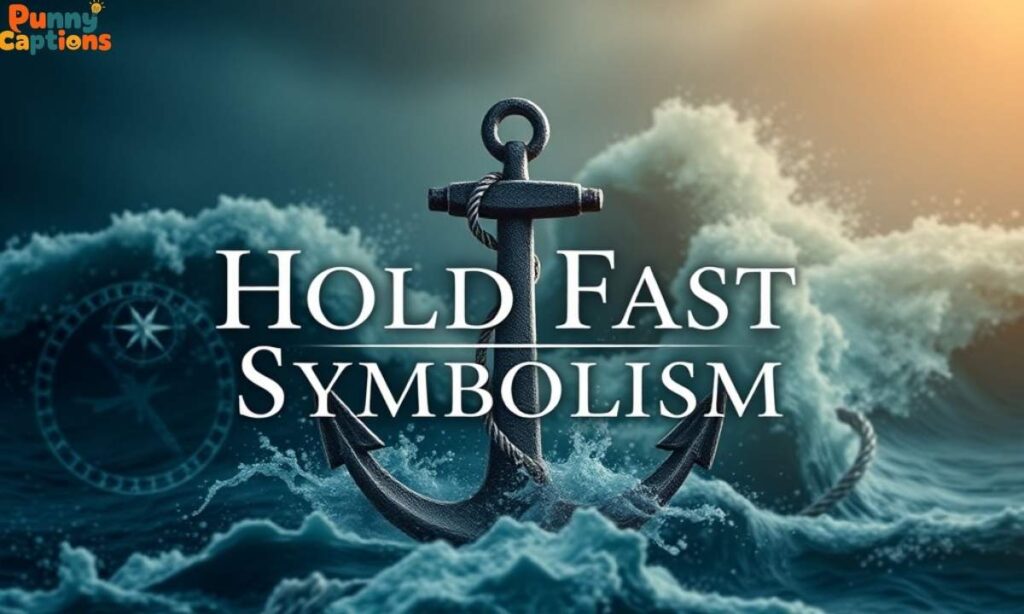
- The anchor is the most natural symbol associated with “hold fast” — both hold against the pull of the current.
- Symbolically, the phrase represents the human refusal to be swept away by forces larger than the self.
- The rope is another symbol — the thing you hold fast to when you are in danger of falling.
- The phrase symbolizes the tension between staying and going, between courage and the desire to flee.
- Hold fast is a symbol of loyalty in its most physical and demanding form.
- The knuckle tattoo symbolizes that every act of your hands carries the reminder to grip and stay.
- Symbolically, “hold fast” is the philosophy of the anchor applied to the human character.
- The phrase symbolizes deep roots — the part of the tree that holds even when the branches whip in the wind.
- It is symbolic of integrity — being the same person you were when you made the promise.
- The ship in the storm is the universal symbol behind the phrase — and we are all the sailor in it.
- Hold fast symbolizes the choice to endure when enduring is harder than the alternative.
- The phrase is symbolic of devotion — the willingness to maintain your grip long after it stops feeling easy.
- Symbolically, the phrase represents the point where faith and action become the same movement.
- The wave is the symbol of everything that tries to dislodge you — hold fast is the grip that answers it.
- The phrase symbolizes the irreplaceable value of staying in an era that celebrates leaving.
- Hold fast is symbolic of legacy — what is left when everything else is stripped away.
- The compass symbolically pairs with hold fast: one tells you where to go, the other reminds you not to drift.
- Symbolically, the phrase is the two-word answer to every force that says you should give up.
- Hold fast is the symbol of human endurance so complete that it crosses culture, religion, and era without losing its meaning.
- The symbol behind hold fast is simple: the hand that will not open, no matter what tries to pry it apart.
Frequently Asked Questions
What Is the Hold Fast Meaning?
Hold Fast means to stay strong and firm. It tells someone not to give up.
What Does Hold Fast Mean in the Bible?
In the Bible, Hold Fast means to remain faithful. It encourages strong belief and trust.
What Does Hold Fast Mean in Love?
In love, Hold Fast means to stay committed. It shows loyalty during hard times.
Is Hold Fast a Positive Phrase?
Yes, Hold Fast is a positive phrase. It gives strength and motivation.
Where Did Hold Fast Originate?
Hold Fast has old English roots. Sailors often used it as a symbol of strength.
How Do You Use Hold Fast in a Sentence?
You can say, “Hold fast to your dreams.” It means never stop believing.
What Is the Spiritual Meaning of Hold Fast?
Spiritually, Hold Fast means keep faith strong. It reminds people to trust their path.
Why Is Hold Fast Popular Today?
It is popular because it inspires courage. Many people use it as a life motto.
What Is the Difference Between Hold Fast and Stay Strong?
Both mean remain firm, but Hold Fast sounds deeper and older. It carries a stronger emotional tone.
Can Hold Fast Be Used as a Motto?
Yes, many people use Hold Fast as a motto. It represents strength, faith, and determination.
Conclusion
Understanding Hold Fast shows us the power of simple words. It reminds us to stay strong in every situation. The meaning is clear and easy to remember. That is why people still use it today.
This phrase teaches patience and courage. It encourages us not to quit too soon. In hard times, it gives hope and support. Its message feels timeless and inspiring.
The relevance of Hold Fast remains strong. It fits in personal life and daily struggles. Anyone can connect with its powerful message. That is why it continues to matter.